
The Puzzle
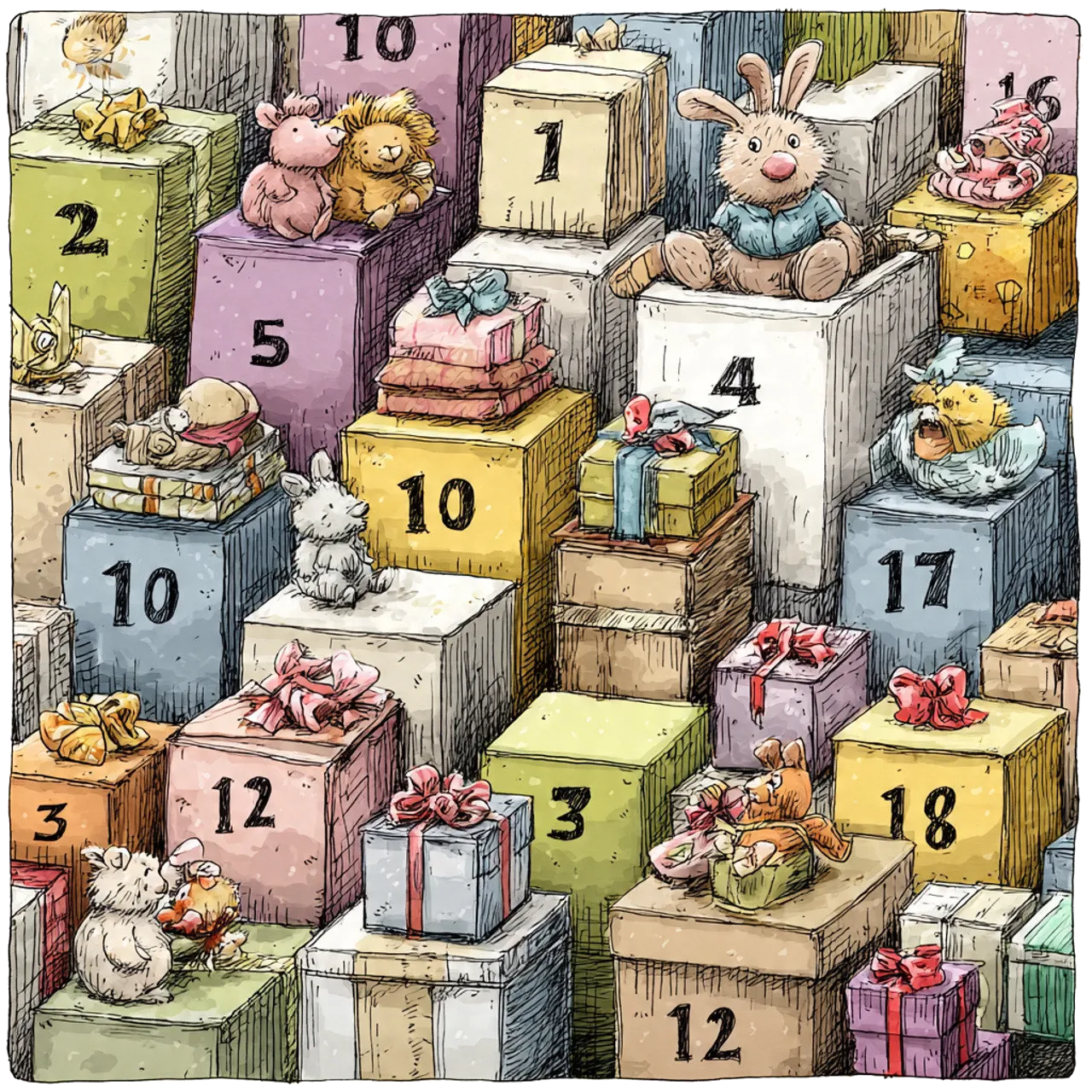
Charlie puts 26 presents in 100 boxes, labeled 1 to 100. Each second, Alice and Bob look in one box. Alice opens them in order (1,2,3,…), while Bob opens the odds first, then the evens (1,3,5,…,2,4,6,…) Who is more likely to see all 26 presents first?
Intuitive Solution
To get a sense of what the answer is, we can break down the puzzle into two cases: the case where the highest numbered box that contains a present is even, and the case where the highest numbered box that contains a present is odd. The probability of each case is roughly 50% (although not quite, which we’ll prove in the following section).
If the highest numbered box that contains a present is even, Bob cannot win. This is because both Alice and Bob reveal the 26th present precisely when they open this box. Since Alice opens all even boxes before Bob (with the small exception of box 100, which they both open at the same time), she is guaranteed to never lose in this scenario.
If the highest numbered box that contains a present is odd, there are still plenty of scenarios in which Alice wins. Take, for example, the scenario where the two highest numbered boxes with presents in them are boxes 80 and 81. Alice reveals all 26 presents in 81 seconds, but it will take Bob 90 seconds to do the same (50 seconds to uncover all the odd boxes, and then 40 more seconds to uncover even boxes until he uncovers box 80).
By looking at the two scenarios above, we can intuitively conclude that Alice should be more likely to reveal all 26 presents first.
Rigorous Solution
Intuition is nice and all, but cold hard numbers are better! We begin our rigorous solution by calculating the exact probabilities of the two cases outlined above - that the highest numbered box that contains a present is even / odd. First, let’s define three terms that will be used extensively in the rest of this writeup:
: the highest numbered box that contains a present
: the probability a given box contains a present, (0.26)
: the probability a given box does not contain a present, (0.74)
With our terms defined, we can now calculate the aforementioned probabilities:
It follows from the above that the probability of being odd is 0.4253.
Additionally, let’s calculate the probability that all 26 presents happen to be placed into even boxes:
As there are the same amount of even and odd boxes, the probability that all 26 boxes happen to be placed into odd boxes is also . Since these probabilities are extremely small, I’ll save us some time and digital paper by disregarding these scenarios in future calculations - including them wouldn’t make a noticeable difference in our final computed probabilities.
Finally, let’s calculate the amount of time it takes Alice and Bob to reveal all 26 presents. For this, we’ll define two additional terms:
: the highest even-numbered box that contains a present
: the highest odd-numbered box that contains a present
Defining these terms makes calculating how long it takes each participant to reveal all 26 presents simple - Alice reveals the 26th present in exactly seconds, while Bob reveals the 26th present in exactly seconds (Bob reveals all 50 odd boxes first, then reveals all even boxes sequentially until he reveals box ).
Armed with the above information, we can now begin calculating the exact probability that Bob reveals all 26 presents first.
Calculating Bob’s Probability to Win
First, we split the possible configurations of presents into two cases, > , and < 0.
e > o:
Alice reveals all 26 presents in seconds, and Bob reveals all 26 presents in seconds. For any , . Therefore, Bob can never win in this scenario.
e < o:
Alice reveals all 26 presents in seconds, and Bob reveals all 26 presents in seconds. Therefore, Bob wins if . We can calculate Bob’s overall probability of winning by taking the weighted average of his probability of winning over all possible values of as follows:
Note that this probability is technically an approximation, as conditional probabilities are equal to their unconditional counterparts only if the random variables in question are independent. That is, only if and are independent. In this case, and actually have a (very) weak inverse correlation. To understand the inverse correlation intuitively, imagine that . This means that there are 25 odd boxes with presents in them, immediately forcing . This constraint does not exist if . Luckily for us, this correlation only becomes noticeable for very low values of and . These scenarios are extremely unlikely, so treating and as independent random variables will not noticeably skew our final computed probabilities.
With that out of the way, let’s breakdown into something we can actually calculate:
We’ll do the same for :
With all of the above, we can finally calculate Bob’s probability of revealing all 26 presents first:
Calculating The Probability of a Tie
We again split the possible configurations of presents into two cases, and .
e > o:
Alice reveals all 26 presents in seconds, and Bob reveals all 26 presents in seconds.
only when e = 100, so the the probability of a tie is simply the probability that , or 0.26.
e < o:
Alice reveals all 26 presents in seconds, and Bob reveals all 26 presents in seconds. Therefore, a tie occurs when . This probability can again be calculated by taking a weighted average over all possible values of :
Notice that just like when we calculated Bob’s probability to win, we again treat and as independent random variables. We’ll show how inconsequential this approximation is in the upcoming section.
Combining the above two scenarios, we arrive at an overall probability of for a tie.
Checking Our Work
At this point you may be wondering if I’m just throwing numbers around and hoping no one looks too close. Or maybe you’re skeptical of all those times I treated and as independent random variables even though they’re technically not. Well, in this section I put both doubts to rest. Let’s start by reminding ourselves of the probabilities we calculated:
Probability Bob wins: (0.2394)
Probability of a tie: (0.3441)
Probability Alice wins: (0.4165) (derived from the above)
Now, let’s bang out a simple program that estimates the true probabilities by running a bunch of simulated games:
import random
def simulate_boxes(num_simulations):    num_ties = 0    alice_wins = 0    bob_wins = 0    alice_order = list(range(1, 101))    bob_order = list(range(1, 100, 2)) + list(range(2, 101, 2))    for _ in range(num_simulations):        chosen_numbers = set(random.sample(range(1, 101), 26))        alice_presents_seen = 0        alice_time = 0        for time, box in enumerate(alice_order):            if box in chosen_numbers:                alice_presents_seen += 1                if alice_presents_seen == 26:                    alice_time = time + 1                    break        bob_presents_seen = 0        bob_time = 0        for time, box in enumerate(bob_order):            if box in chosen_numbers:                bob_presents_seen += 1                if bob_presents_seen == 26:                    bob_time = time + 1                    break        if alice_time == bob_time:            num_ties += 1        elif alice_time < bob_time:            alice_wins += 1        else:            bob_wins += 1
    alice_probability = alice_wins / num_simulations    bob_probability = bob_wins / num_simulations    tie_probability = num_ties / num_simulations
    print(f"Alice win probability: ({alice_probability*100:.2f}%)")    print(f"Bob win probability: ({bob_probability*100:.2f}%)")    print(f"Tie probability: ({tie_probability*100:.2f}%)")
if __name__ == "__main__": simulate_boxes(1000000)#include <algorithm>#include <array>#include <iomanip>#include <iostream>#include <numeric>#include <random>
void simulate_boxes(int num_simulations) { int num_ties = 0; int alice_wins = 0; int bob_wins = 0; std::random_device rd; std::mt19937 gen(rd()); std::array<int, 100> numbers; std::array<int, 100> alice_order; std::array<int, 100> bob_order; std::iota(numbers.begin(), numbers.end(), 1); std::iota(alice_order.begin(), alice_order.end(), 1); int index = 0; for (int box = 1; box <= 100; box += 2) { bob_order[index++] = box; } for (int box = 2; box <= 100; box += 2) { bob_order[index++] = box; } std::array<int, 26> selected; for (int sim = 0; sim < num_simulations; ++sim) { std::sample( numbers.begin(), numbers.end(), selected.begin(), selected.size(), gen ); std::array<bool, 101> chosen{}; for (int box : selected) { chosen[box] = true; } int alice_presents_seen = 0; int alice_time = 0; for (int time = 0; time < 100; ++time) { int box = alice_order[time]; if (chosen[box]) { ++alice_presents_seen; if (alice_presents_seen == 26) { alice_time = time + 1; break; } } } int bob_presents_seen = 0; int bob_time = 0; for (int time = 0; time < 100; ++time) { int box = bob_order[time]; if (chosen[box]) { ++bob_presents_seen;
if (bob_presents_seen == 26) { bob_time = time + 1; break; } } } if (alice_time == bob_time) { ++num_ties; } else if (alice_time < bob_time) { ++alice_wins; } else { ++bob_wins; } }
double alice_probability = static_cast<double>(alice_wins) / num_simulations; double bob_probability = static_cast<double>(bob_wins) / num_simulations; double tie_probability = static_cast<double>(num_ties) / num_simulations; std::cout << std::fixed << std::setprecision(2); std::cout << "Alice win probability: "<< alice_probability * 100 << "%\n"; std::cout << "Bob win probability: " << bob_probability * 100 << "%\n"; std::cout << "Tie probability: " << tie_probability * 100 << "%\n";}
int main() { simulate_boxes(1000000); return 0;}Output:
Alice win probability: (41.65%)
Bob win probability: (23.95%)
Tie probability: (34.40%)
Our calculated probabilities are less than a hundredth of a percent off of the estimated true probabilities - well within the bounds of variance!
Conclusion
Whew, that turned out to be way more work than I was expecting! If you enjoyed this puzzle breakdown, take a look at some of the other ones on this blog, or peep my interactive puzzle website! Also check out Daniel Litt on Twitter - I was inspired to make this breakdown when a friend sent me this Twitter poll:
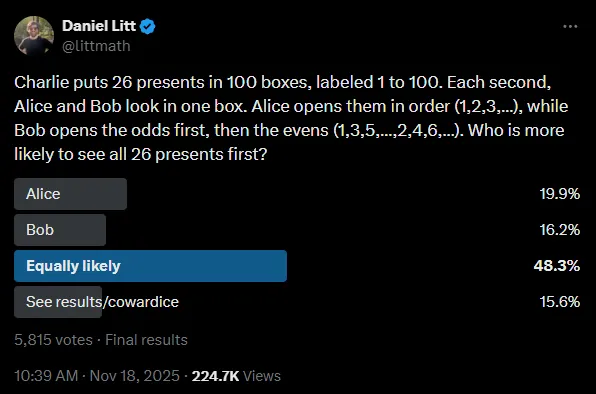
More than 80% of people were bamboozled by this puzzle!